Introduction: The Art of the Virtual Patient
There is a specific kind of silence that falls in the operatory when a patient with terminal dentition first looks in the mirror after a full-arch rehabilitation. It’s a moment where clinical science meets human emotion. But as specialists, we know that this “magic” moment isn’t magic at all—it is the result of a meticulously orchestrated symphony of data.
When a complex case walks through your door, you aren’t just a surgeon or a prosthodontist; you are a curator of possibilities. You are taking raw, fragmented data—CBCT scans, intraoral maps, and facial captures—and weaving them into a single, photorealistic “Virtual Patient.”
At The Digitalista, we believe that full-arch rehab shouldn’t feel like a high-stakes gamble. It should feel like the execution of a well-designed masterpiece. By moving from the “analog guess” to the “digital certain,” we don’t just restore teeth; we restore confidence—both yours and the patient’s.
The Visionary’s Challenge: Why Integration is Everything
Full-arch rehabilitation is perhaps the most complex “canvas” in dentistry. You aren’t just replacing teeth; you are re-establishing a vertical dimension, managing bone resorption, and harmonizing a new smile with the unique architecture of a human face.
1. The “Virtual Patient” Concept
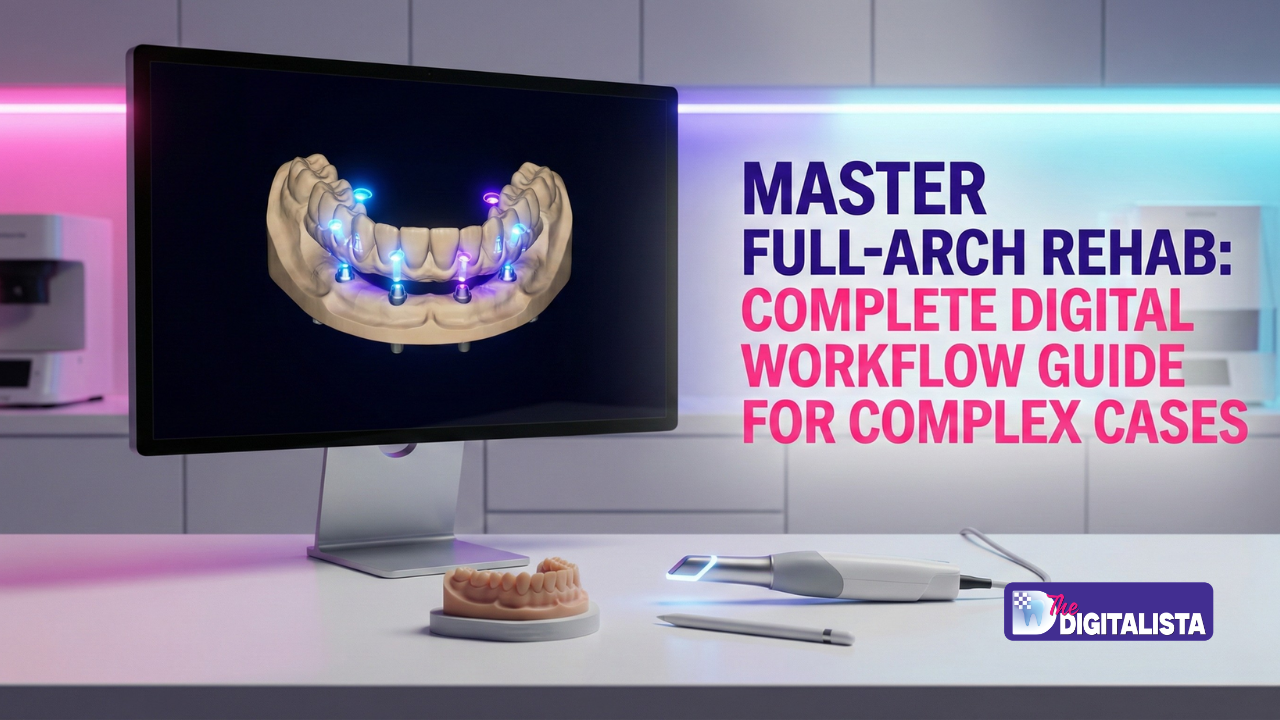
In the old world, we planned in silos. We looked at a 2D X-ray, then a stone model, then the patient’s face, and tried to “merge” them in our minds. Today, we create a Virtual Patient. This is a 3D digital twin where hard tissue, soft tissue, and facial proportions exist in their true spatial relationships. This isn’t just a cool visual; it’s your North Star.

2. The Precision Mandate
The stakes in full-arch cases are unforgiving. A deviation of just 1-2 millimeters can be the difference between a passive fit and a prosthetic nightmare. Digital workflows have been shown to reduce implant deviations by three-fold compared to freehand placement [1]. In our world, precision is the highest form of care.
3. Prosthetically-Driven Planning
We no longer place implants where the bone is and “hope” the teeth fit on top. We design the smile first. We curate the ideal tooth position, the smile arc, and the lip support, and then we command the implants to support that vision. This “reverse” engineering is what separates a good result from a masterpiece.

The 5 Pitfalls in Your Full-Arch Workflow
Even the most seasoned artisans can encounter “leaks” where precision is lost. Here is how to plug them:
1. The “Metal Fog” (CBCT Artifacts)
Existing crowns and bridges create “scatter” that can obscure critical landmarks like the mandibular canal.
- The Artisan’s Fix: Don’t settle for “foggy” data. Use AI-powered Metal Artifact Reduction (MAR) to clear the view, or manage restorations pre-scan to ensure your bone segmentation is flawless.
2. The “Data Drift” (Registration Errors)
Merging a surface scan (IOS) with a bone scan (CBCT) is the most critical “handshake” in the workflow. If this is off, the entire foundation is compromised.
- The Artisan’s Fix: In edentulous cases, never rely on soft tissue alone for registration. Use fiducial markers—fixed reference points that ensure your data sets are locked in a perfect embrace.
3. The “Soft Tissue Blind Spot”
Many plans focus entirely on bone, leaving the gingival margins to chance.
- The Artisan’s Fix: Proactive soft tissue planning. Use facial scanning to see how the lips interact with the teeth. Design your “FP-1” or “FP-3” restoration in the virtual world first to ensure the transition lines are hidden and the papillae are respected.
4. The “Space Race” (Restorative Assessment)
Underestimating the vertical space needed for a bridge is a classic “Tuesday afternoon” disaster.
- The Artisan’s Fix: Use your digital wax-up to measure the exact distance from the implant platform to the opposing arch. If you need 12mm for a hybrid bridge, ensure you have it before you start the surgery.
5. The “Stability Gamble”
Immediate loading is the “Same-Day Wow” our patients crave, but it requires objective proof of stability.
- The Artisan’s Fix: Don’t guess the torque. Use Hounsfield units in your CBCT to assess bone density (D1-D4) before you drill. If the “foundation” is soft, adjust your protocol early to ensure success.
The Digitalista Protocol: Orchestrating the Workflow
Phase 1: The Collection (Data Acquisition)
We gather the “raw materials”: CBCT for the bone, IOS for the tissue, and 3D facial scans for the soul of the smile. This is where the Virtual Patient is born.
Phase 2: The Design (Virtual Wax-up)
We curate the smile. We establish the incisal edge, the smile arc, and the buccal corridors. We show the patient their future before we ever touch a handpiece. This reduces revision requests by nearly 50% [2].
Phase 3: The Blueprint (Implant Planning)
With the smile locked in, we place the implants. We ensure 4-5mm of space between platforms and 2mm of clearance from vital structures. We design “stackable” guides that handle everything from bone reduction to final placement.
Phase 4: The Execution (Surgical Delivery)
The “performance.” We use our guides to translate the digital vision into physical reality. We verify the “seating” through inspection windows and confirm primary stability (ITV > 32 Ncm) for that immediate loading “wow.”

Choosing Your Canvas: The Digital Advantage

| Feature | Analog Workflow | The Digitalista Workflow |
| Planning Base | Subjective Guesswork | The “Virtual Patient” (3D) |
| Implant Accuracy | 3-5mm Deviation | < 1.2mm Deviation |
| Patient Experience | Multiple “Try-ins” | “Same-Day” Function |
| Success Rate | 85-92% | 95-99% |
The Artisan’s Final Review: Your Full-Arch Checklist

Before you begin your next masterpiece, ensure these elements are in place:
- ☐Is the “Virtual Patient” registered with sub-millimeter accuracy?
- ☐Has the restorative space been measured against the digital wax-up?
- ☐Is the bone density (HU) mapped for every implant site?
- ☐Does the smile design harmonize with the 3D facial scan?
- ☐Is the surgical guide “stackable” for maximum efficiency?
Your Next Step Toward Visionary Dentistry
Full-arch rehabilitation is the ultimate expression of our skill as specialists. It’s where we change lives in a single day. By mastering the digital workflow, you aren’t just placing implants; you are orchestrating a transformation.
Ready to lead the way in full-arch excellence?
Join our Full-Arch Digital Mastery Course. We’ll show you the exact protocols we use to create Virtual Patients and deliver predictable, life-changing results.
👉 Secure Your Spot in the Course Now
Have a complex terminal dentition case on your desk? Book a 1:1 Case Planning Call with Dr. Samira to curate the perfect digital plan together.