Introduction: Mastering the Diagnostic Compass
We’ve all been there. You’ve spent hours prepping a complex anterior case, the patient is excited, and you’ve done your best to communicate the vision. But when the final restorations come back from the lab, something is… off. Maybe the midline is slightly tilted, or the incisal edges feel just a fraction too long for the patient’s lip line.
Suddenly, that “perfect” smile feels like a compromise. You’re left making chairside adjustments while the patient’s initial excitement turns into quiet uncertainty.
In the world of high-end cosmetic dentistry, “close enough” isn’t enough. Our patients aren’t just looking for new teeth; they are looking for a transformation that feels like them. Historically, we relied on analog wax-ups—a process that involved a fair amount of “educated guesswork” and manual labor.
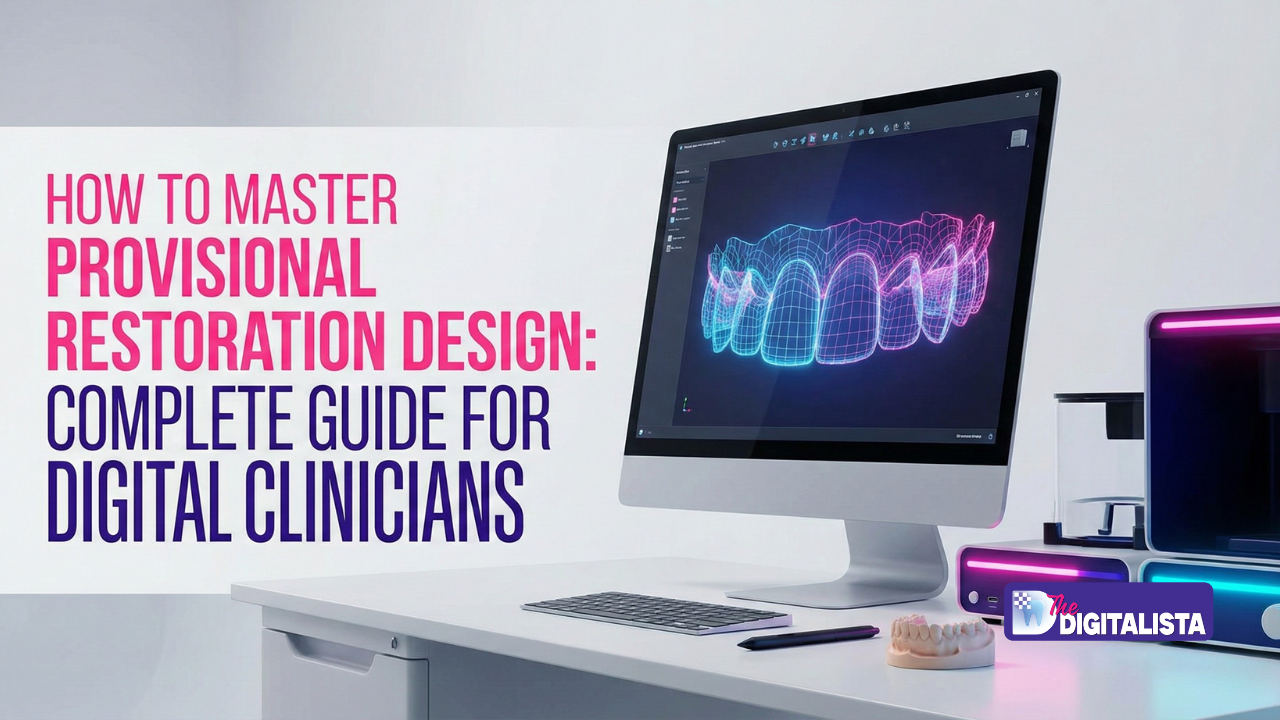
Today, the landscape has shifted. Digital smile design, anchored by the digital wax-up, has turned that uncertainty into near-absolute certainty. Imagine showing your patient a high-fidelity, 3D preview of their new smile before you even touch a bur. This isn’t just a “cool tool”—it’s your diagnostic compass.
Why Precision is Your New Best Friend

1. Confidence You Can See
A digital wax-up isn’t just for you; it’s for your patient. When they can see, critique, and approve their future smile in 3D, their anxiety melts away. This visual certainty is the single biggest driver of case acceptance.
2. Respecting the Biology
We believe in “clarity without complexity.” By designing the final tooth form first, you can create a precise reduction guide. This ensures you remove only what is necessary—preserving healthy tooth structure and avoiding post-operative sensitivity.
3. Harmony in Motion
A smile doesn’t just sit still. The digital process allows us to integrate dynamic occlusion. We can analyze how the teeth interact when the patient speaks and moves, ensuring the final result is as functional as it is beautiful.
The 4 Common Pitfalls (And How to Avoid Them)
Even with the best technology, things can go wrong if the workflow is flawed. Here is where most practitioners struggle:
1. The “Garbage In, Garbage Out” Rule
Your design is only as good as your data. If your initial intraoral scan is rushed or missing the emergence profile, your final restoration won’t fit the physical reality.
- The Fix: Take your time. Ensure the lips and cheeks are retracted, and always verify the bite registration in the software before moving forward.
2. The 2D-to-3D Disconnect
It’s easy to make a 2D photo look great, but transferring that to a 3D model is where the “magic” often fails. If the virtual plane of occlusion doesn’t match the patient’s actual facial midline, the teeth will look “false” or tilted.
- The Fix: Use a Virtual Facebow protocol. Align your model to the patient’s interpupillary line and facial midline.
3. Ignoring the “Bite” for the “Beauty”
Software makes it easy to sculpt gorgeous teeth, but if they interfere with the patient’s natural jaw movements, they will fail.
- The Fix: Always check your design against the opposing arch using virtual articulation. A stable bite is just as important as a perfect incisal edge.
4. The Bridge to Reality
The most beautiful digital design is useless if it doesn’t translate to the patient’s mouth.
- The Fix: Never skip the physical mock-up. Use your digital file to 3D print a matrix and test the design chairside. This is the “test drive” that guarantees success.
Your Step-by-Step Path to Mastery
Mastering the digital wax-up requires a disciplined, yet intuitive, protocol. Here is how we do it at The Digitalista:

Step 1: The Triple-Layer Data Capture
Don’t just scan teeth. Capture the whole story:
- High-Fidelity IOS: A clean, high-res scan of both arches.
- Facial Data: A 3D facial scan or standardized photography with a reference scale.
- Video Analysis: Watch them speak and smile. This is the only way to see how the lips interact with the teeth.
Step 2: Facial-Driven Alignment
This is the “calm authority” phase. We align the dental midline with the facial midline and set the incisal edge position based on the resting lip line. This step is non-negotiable.
Step 3: The Art of Sculpting
Start with a tooth library that matches the patient’s personality—whether that’s soft and ovoid or strong and square.
- Pro-Tip: Use mirroring. If they have one perfect central incisor, mirror it to the other side for instant, natural symmetry.
Step 4: The Digital-to-Physical Bridge
Once the design is approved, print your reduction guide and your mock-up template. This is where your digital planning meets clinical reality.
Choosing Your Tools: Proprietary vs. Open Source
At The Digitalista, we often advocate for Blender for Dental. While proprietary systems (like Exocad or 3Shape) are excellent for high-volume, standard cases, Blender offers the “optimum strength” of absolute creative control.
| Feature | Proprietary (Exocad/3Shape) | Open Source (Blender for Dental) |
| Cost | High fees + annual updates | Low cost / No licensing fees |
| Control | Limited to vendor libraries | Unlimited artistic freedom |
| Best For | Speed and standard workflows | Esthetic specialists & custom designs |
The Final Checklist for Success

Before you hit “send” to the lab, ask yourself:
- ☐ Is the model aligned with the facial horizon?
- ☐ Can the patient make “S” and “F” sounds without interference?
- ☐ Is there enough space (1.0-1.5mm) for the final material?
- ☐ Does the design respect the biological width?
Your Next Step Toward Confidence
The age of predictable esthetics isn’t coming—it’s here. Mastering this workflow is what separates a good dentist from a visionary one. It’s about reducing chair time, eliminating remakes, and building a reputation for excellence.
Ready to stop guessing and start designing?
Join our Digital Wax-Up Fundamentals Course. We’ll take you from “software overwhelm” to “confident creator” with step-by-step protocols you can use on your very next case.
👉 Secure Your Spot in the Course Now
Not sure where to start? Book a 1:1 Case Planning Call with Dr. Samira to review your next big case together.
