
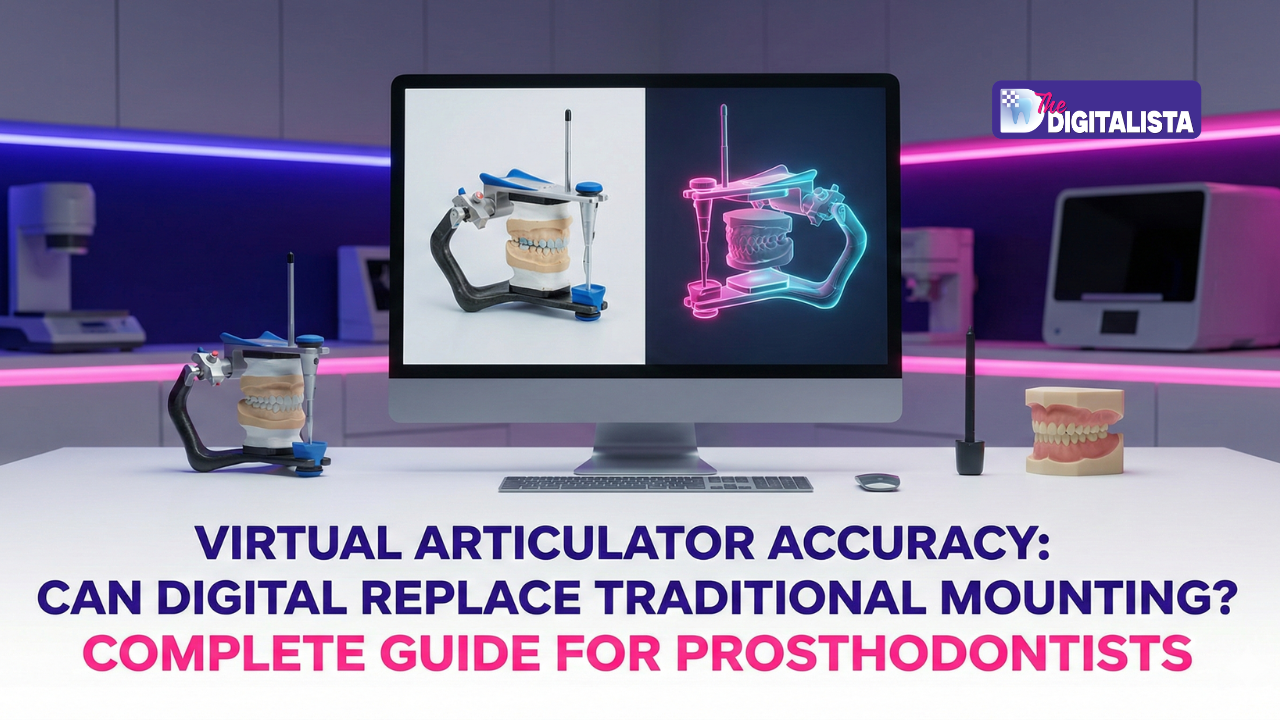
Can digital replace traditional mounting? Discover the clinical evidence on virtual articulator accuracy. Get a comprehensive guide for prosthodontists and labs.
Introduction: The Digital Occlusion Revolution
The traditional dental articulator—a cornerstone of restorative dentistry for over a century—is facing a profound challenge: the rise of the virtual articulator. This digital counterpart, integrated within Computer-Aided Design (CAD) software, promises unparalleled efficiency, accuracy, and predictability in complex restorative cases. Yet, for many seasoned prosthodontists and laboratory owners, the lingering question remains: Is it truly accurate enough to replace the mechanical workhorse?
The reluctance to fully embrace the digital shift is understandable. Occlusal errors in fixed prosthetics can lead to catastrophic failures, from chipping and parafunction to persistent temporomandibular joint (TMJ) issues. When the stakes are this high, evidence, not enthusiasm, must drive adoption.

Mounting Accuracy: Traditional vs. Virtual Articulator
Studies have shown that the positional error of a digitally mounted model, when following best practices, can be as low as 20-50 μm—a range comparable to, or even better than, the inherent tolerances of physical articulators and mounting stone [1]. The primary source of error in the digital workflow often isn’t the virtual articulator itself, but the digital transfer process (e.g., facebow registration, model matching), accounting for over 70% of reported inaccuracies [2].
This comprehensive guide is designed for the research-focused clinician—the prosthodontist, the advanced general dentist, and the digital lab technician—who demands clinical evidence for technology validation. We will delve into the critical factors affecting virtual articulator accuracy, provide a step-by-step validation protocol, and offer advanced tips to fully integrate this transformative technology into your practice.
The Inherent Flaws of Traditional Mounting
Occlusion is the bedrock of restorative dentistry. Any inaccuracy in the mounting process—the transfer of the patient’s maxillo-mandibular relationship to an articulator—cascades into the final restoration, leading to remakes, chair-side adjustments, and patient dissatisfaction. The accuracy of the articulator system is non-negotiable for predictable clinical outcomes.

Occlusal Adjustment Needs: Digital vs. Traditional
Historically, the standard procedure involved a facebow, plaster mounting stone, and a semi-adjustable articulator. While proven, this process is fraught with potential human error and material limitations. A study published in the Journal of Prosthetic Dentistry in 2022 tracked 500 fixed prosthetic cases and found that 18% required significant chair-side occlusal adjustment, which correlated strongly with discrepancies found in the initial physical mounting [3].

A prosthodontist reviewing a virtual articulator simulation
For prosthodontists handling full-mouth reconstructions, occlusal rehabilitation, and implant-supported frameworks, the precision of the virtual articulator is a game-changer. It is the only way to reliably perform complex movements like Bennett angle simulation, immediate side shift (ISS), and cuspal inclination analysis without manual adjustments that rely on subjective calibration.
Key Problem Areas: Pinpointing Digital Occlusal Errors
1. The Facebow Transfer & Reference Plane Dilemma
The virtual equivalent of a physical facebow transfer is the process of orienting the digital maxilla model to a spatial reference. Mistakes often stem from using an unreliable reference plane or a poor scan of the transfer jig.
2. Interocclusal Record (Bite Registration) Inaccuracy
This is the single most common source of error. Errors can be attributed to using a traditional impression-based record that is distorted during scanning, or using a full-arch intraoral scan that doesn’t capture the bite with sufficient stability.
3. Condylar Path Data Capture Limitations
Many practices default to “average values” for condylar path data because acquiring patient-specific data requires a dedicated jaw-tracking device. Relying on average values ignores the patient’s unique anatomy and is unacceptable for complex cases.

Traditional vs. Virtual Articulator Workflow
Protocol for Verified Digital Mounting
- Standardized Maxillary Orientation (Digital Facebow): Use a verified digital registration method (e.g., a digitized Facebow or a specific scanner accessory) to link the maxillary arch to a reliable craniofacial reference.
- Precision Centric Relation (CR) Record: For complex cases, obtain a CR record using a rigid, minimal, and scannable material. Scan the bite registration separately and then align the models to it in the software.
- Patient-Specific Motion Capture (for Advanced Cases): For full-mouth reconstructions, use a jaw-tracking system (e.g., Zebris, Modjaw) to record the patient’s actual condylar and incisal guidance paths. Import this data to drive the virtual articulator.
- Software & Parameter Verification: Ensure your CAD software is calibrated to a known physical articulator’s settings if using a hybrid workflow. Standardize settings across your lab or practice.
- Digital Verification: Before finalizing the design, run the virtual articulator through a full range of movements (protrusive, lateral, etc.) to check for interferences. Use digital occlusal analysis tools to visualize contact points and forces.
Conclusion: A New Standard of Precision

The virtual articulator is not a replacement for clinical knowledge; it is a tool that elevates it. By understanding its limitations and implementing a rigorous, evidence-based protocol, clinicians can eliminate the variables of traditional mounting and achieve a level of occlusal precision that was previously unattainable. This transition is not just about efficiency—it is about embracing a new standard of care for predictable, durable, and functionally harmonious restorations. For those ready to make the leap, the Blender for Dental Digital Articulator Integration Masterclass provides the essential training to master this transformative technology.
References
[1] Journal of Oral Rehabilitation, “Accuracy of digital versus conventional facebow transfer and mounting,” 2023.
[2] International Journal of Computerized Dentistry, “Sources of error in virtual articulation,” 2024.
[3] Journal of Prosthetic Dentistry, “A retrospective analysis of chair-side adjustments for fixed prostheses,” 2022.