
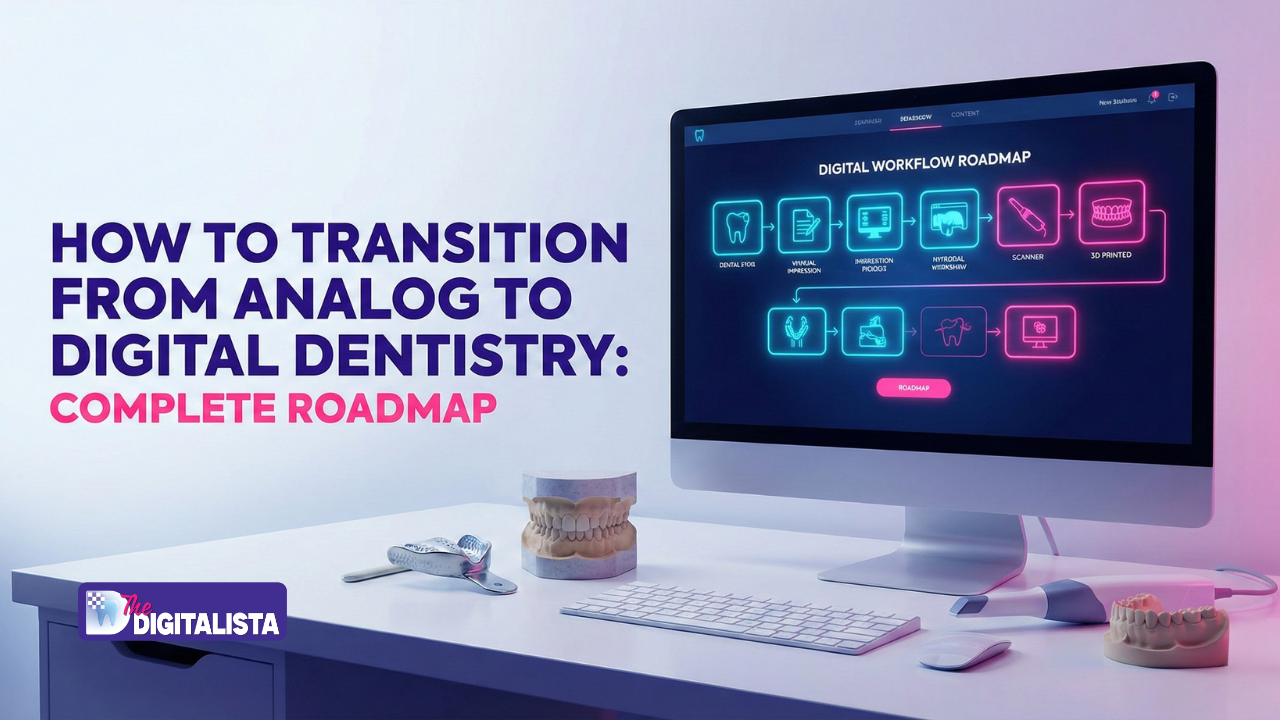
A Strategic, Step-by-Step Roadmap for Practice Owners Who Want Growth — Not Chaos
Transitioning from analog to digital dentistry? Learn how to implement intraoral scanners, CAD/CAM, 3D printing, and CBCT with minimal disruption. This complete roadmap covers ROI, staff training, workflow integration, and technology selection for modern dental practices.
The Real Pain Point No One Talks About
You’re still taking PVS impressions. Your assistant is disinfecting trays. Your lab bill hits your inbox again.
Meanwhile, the clinic down the street is delivering same-day crowns and posting it on Instagram.
And here’s the part that stings:
You know digital dentistry is the future. You just don’t know how to adopt it without:
- Tanking production for 3 months
- Overwhelming your team
- Wasting six figures on the wrong system
You’re not alone.
Only 57% of U.S. practices use intraoral scanners, and even fewer have fully integrated digital workflows — despite overwhelming evidence that digital dentistry improves efficiency, profitability, and patient experience.
Digital workflows reduce procedure time by 38% on average.
Patients prefer digital impressions 89% of the time.
The global digital dentistry market is projected to reach $15.2 billion by 2030, growing at 9.6% annually.
So the question isn’t if you should transition.
It’s how to do it strategically — without chaos. This is your roadmap.
Why Staying Analog Is Quietly Costing You More Than You Think
Digital dentistry isn’t about “cool tech.” It’s about clinical leverage.
Here’s what the data shows:
- Digital workflows reduce total treatment time by 60.36% across procedures.
- Digital impressions reduce waiting time from two weeks to 2–3 days (75–85% faster).
- Acceptance rates for digital restorations are 53.3% higher than traditional impressions.
- Fully integrated digital practices report 30–40% higher production per clinical hour.
But numbers aside — let’s talk real life.
Real-World Consequences of Staying Analog
- Patients compare you to competitors offering same-day dentistry.
- Labs increasingly prefer digital files (some even charge more for analog).
- Younger associates expect digital systems.
- Complex cases are harder to plan and present.
And here’s the quiet truth:
Every year you delay, the skill gap grows.

The 5 Major Challenges No Vendor Will Warn You About
Let’s be honest. Digital transition isn’t plug-and-play.
1. Capital Investment Shock
Scanner: $15,000–$45,000
CAD/CAM: $80,000–$150,000
CBCT: $65,000–$150,000
3D Printer: $3,000–$15,000
The mistake isn’t the investment.
It’s investing without a staged plan.
2. The Learning Curve Is Real
Most practices fail to achieve expected ROI because of inadequate training.
Not because the technology is bad.
Because the team isn’t prepared.
Expect:
- 6–12 weeks productivity dip
- 20–30% slower appointments initially
- Emotional resistance from experienced staff
This is normal. Not failure.
3. Workflow Disruption
Digital dentistry is not analog with a scanner.
It changes:
- Appointment sequencing
- Lab communication
- Treatment presentation
- Scheduling blocks
Without redesign, it creates stress.
4. Choosing the Wrong Ecosystem
Open vs closed systems.
Subscription models.
Proprietary materials.
Upgrade paths.
Choose wrong — and you’re locked in.
5. Poor ROI Tracking
If you don’t track:
- Utilization rate
- Chair time reduction
- Lab cost changes
- Case acceptance shifts
You’ll never see the full picture.
The Strategic 4-Phase Roadmap
We do this calmly. Sequentially. Intentionally.

Phase 1: Assessment (Weeks 1–4)
Before you buy anything:
Calculate:
- Average chair time per procedure
- Monthly lab expenses
- Remake rates
- Production per hour
Define:
- Same-day dentistry goal?
- In-house aligners?
- Guided surgery?
Set Financial Reality:
Break-even usually occurs between 18–36 months, depending on technology mix.
Clarity first. Equipment second.
Phase 2: Start with Digital Impressions (Months 1–3)
This is your foundation.

Why intraoral scanners first?
Because everything else builds on them.
Implementation should look like this:
Month 1:
- Vendor installation
- Practice scans on team members
- 15–20 extra minutes blocked per appointment
Month 2:
- Single-unit crowns
- Low-stress cases
- Track scan time
Month 3:
- Bridges
- Dentures
- Orthodontic records
Target proficiency:
Full arch in under 5 minutes.
Phase 3: Add 3D Printing(Months 4–6)
Start small.
Best first applications:
- Study models
- Surgical guides
- Night guards
Why? Because they eliminate recurring lab costs quickly.
Many practices reach break-even on 3D printing in 12–24 months.
Phase 4: Chairside CAD/CAM (Months 6–12)Only when:
- You perform 40+ crowns/month
- Your team is comfortable scanning
- Financials show clear ROI
Same-day dentistry isn’t just convenience. It increases case acceptance dramatically. Patients say yes when they don’t need a second appointment.
Break-even typically: 24–36 months.

Phase 5: CBCT + Guided Surgery (Months 12–18)
CBCT transforms:
- Implant planning
- Endodontics
- Surgical precision
When combined with guided surgery, accuracy and confidence increase significantly.
ROI depends on case volume — typically 24–48 months.
Training Is 40% of Your Success
Equipment is only 60%.
The other 40% is:
- Protected learning time
- Digital champions
- Structured SOPs
- Cross-training
Practices implementing technologies sequentially achieve:
- 60% better team adoption
- 40% faster ROI
That’s not about tech. That’s about leadership.
What the Learning Curve Really Feels Like
Month 1:
“Why did we do this?”
Month 3:
“This is getting easier.”
Month 6:
“I can’t imagine going back.”
That’s the arc.

The Emotional Side of Digital Transition
This part matters.
Senior assistants may feel threatened. Associates may feel excited. Patients may feel curious.
Your job is alignment. Not pressure.
When the team feels included, adoption accelerates.
Your Calm, Strategic Next Step
Don’t buy equipment tomorrow. Instead:
This Week:
- Audit lab costs
- Calculate crown volume
- Discuss digital vision with team
This Month:
- Visit 2 digital practices
- Complete live scanner demos
- Build ROI projection
This Quarter:
- Implement scanner
- Protect training time
- Track metrics
Digital dentistry isn’t a purchase. It’s a leadership decision.
If you’re serious about transitioning without chaos:
→ Build your 24-month digital roadmap.
→ Schedule a structured implementation consultation.
→ Start with foundational training before equipment arrives.
Don’t digitize randomly. Digitize strategically.
Your future production — and your team’s confidence — depend on it.