
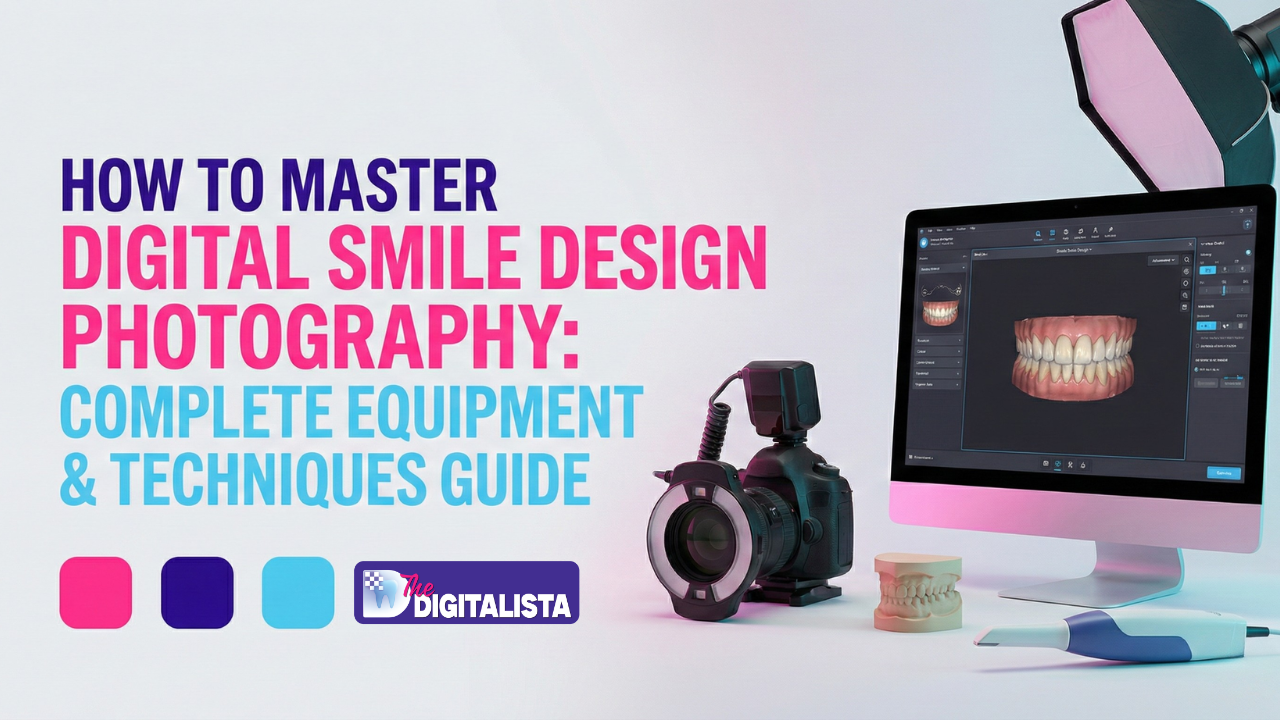
Mastering Digital Smile Design Photography for Predictable, High-Impact Results
Your smile designs are perfect on screen, but fall flat in the clinic. The problem isn’t your design—it’s your photography. This guide reveals the simple, standardized photography protocol that separates predictable outcomes from patient hesitation.
Introduction: The Uncomfortable Truth
Let’s start with a familiar scenario. You spend hours designing the perfect smile. The proportions are harmonious, the midline is aligned, and the incisal edges are balanced. But when you present the case, something feels off. The smile doesn’t look as good as it did on your screen. The patient hesitates. You start explaining more than you should have to.
Here’s the truth most dentists don’t want to admit: It’s not your design. It’s your photography.
In Digital Smile Design (DSD), photography is not documentation. It is the foundation of diagnosis, communication, and predictability. If your photos are inconsistent, distorted, poorly lit, or incorrectly angled, your design will be compromised before it even begins. Let’s fix that.

Why Photography Determines DSD Success
Digital Smile Design relies on the precise calibration of visual reference points: the facial midline, the interpupillary line, lip dynamics, and gingival levels. If your image is tilted, stretched, or shot at the wrong height, these landmarks shift. Even small distortions can lead to incorrect smile lines, misaligned midlines, and ultimately, patient dissatisfaction.
Photography is not cosmetic. It’s clinical. Research consistently shows that even 1–2 mm deviations in midline or gingival levels can be noticed by patients, especially in high-smile cases [1].
The 3 Most Common Photography Mistakes
To achieve clinical precision, we must first eliminate the most common sources of error. These three mistakes are the primary reason that beautiful digital designs fail to translate to the real world.

Head Position Is Not Standardized:: If the patient’s head is tilted, your horizontal references become unreliable. **Natural Head Position (NHP)** is critical. Have the patient look at their own eyes in a mirror placed at eye level to reproduce this consistently.
Camera Height Is Incorrect:: If you shoot from above or below, you distort proportions. The camera lens must be at the same height as the patient’s mid-face and parallel to the facial plane. Shooting from above makes incisors appear shorter; shooting from below exaggerates length.
Inconsistent Framing and Magnification:: If every photo is taken at a different distance, you lose reproducibility. You cannot accurately compare before-and-after shots, mock-ups, or wax-ups. Use fixed magnification ratios and standardized framing for every case.Let’s make this practical.
The Essential DSD Photography Protocol
Here’s the simplified, non-negotiable protocol that ensures you capture all necessary diagnostic information, every single time.

Lighting: The Silent Variable
Lighting affects shade perception, surface texture visualization, and gingival color evaluation. Uneven lighting creates artificial shadows, and shadows create false anatomy. Always use a dual flash system or ring flash against a neutral background to avoid mixed light sources that distort color temperature.
From Diagnosis to Case Acceptance
Photography is not just for design; it is a powerful communication tool. Patients understand images more than explanations. When they see their own asymmetry clearly and calmly presented on screen, they trust your plan more. This visual precision builds emotional trust.very case.


Building a Repeatable Workflow
Confident digital clinicians don’t improvise; they follow a checklist. Create a simple protocol sheet in your clinic to standardize your process.

Your Next Step: Stop Guessing, Start Standardizing
If you want your Digital Smile Design cases to look more natural, feel more predictable, and convert more confidently, start with photography. Not software, not veneers, not composite layering. Photography.
Inside the Digitalista LAB, we teach you how to build a repeatable, calm, confident digital workflow—starting from the first photograph to final delivery. You don’t need more complexity; you need clarity. Explore the LAB and implement a photography protocol you can use tomorrow in your clinic. Because precision is not aggressive. It’s elegant. And elegant dentistry wins.
References
[1] Kokich, V. O., Jr, Kiyak, H. A., & Shapiro, P. A. (1999). Comparing the perception of dentists and lay people to altered dental esthetics. *Journal of Esthetic and Restorative Dentistry*, 11(6), 311-324.wins.